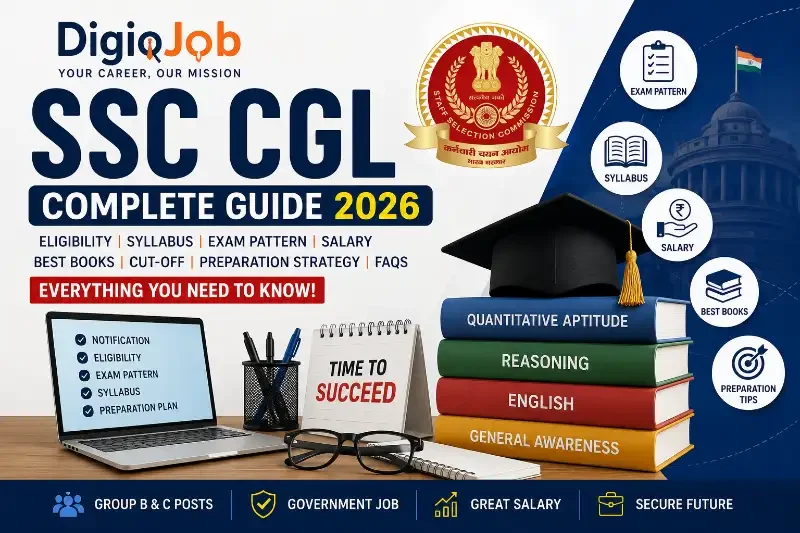
SSC CGL 2026 Complete Guide
The Staff Selection Commission Combined Graduate Level (SSC CGL) Examination is one of the most popular government recruitment exams in India. Every year, lakhs of graduates appear for SSC CGL to secure prestigious Group B and Group C Central Government jobs in ministries, departments, and government organizations.
If your dream is to work as an Income Tax Inspector, Assistant Section Officer (ASO), Central Excise Inspector, GST Inspector, CBI Sub-Inspector, Auditor, Accountant, Tax Assistant, or Junior Statistical Officer, SSC CGL is one of the best opportunities available.
Apart from job security, SSC CGL offers attractive salaries, regular promotions, government allowances, work-life balance, and the opportunity to work in some of India's most respected departments.
This guide covers everything you need to know about SSC CGL, including:
Whether you are preparing for SSC CGL for the first time or looking to improve your strategy, this guide is designed to help you understand the exam from start to finish.
What is SSC CGL?
SSC CGL stands for Staff Selection Commission Combined Graduate Level Examination.
It is conducted by the Staff Selection Commission (SSC) to recruit graduates for various Group B and Group C posts in the Central Government.
Through SSC CGL, candidates are selected for departments such as:
Income Tax Department
Central Board of Indirect Taxes & Customs (CBIC)
Central Bureau of Investigation (CBI)
Ministry of External Affairs
Central Secretariat Service
Comptroller and Auditor General (CAG)
Ministry of Railways
Intelligence Bureau (selected posts)
National Investigation Agency (selected posts)
Various Central Government Ministries and Departments
Unlike many state-level examinations, SSC CGL provides opportunities to work across India under the Central Government.
Why is SSC CGL So Popular?
SSC CGL has consistently remained one of the most sought-after government examinations because it offers a combination of financial stability, career growth, and social prestige.
Some of the major reasons candidates prefer SSC CGL include:
1. Central Government Job
Selected candidates become employees of the Government of India and work in ministries, departments, and autonomous organizations.
2. Attractive Salary
Depending on the post and pay level, employees receive:
Basic Pay
Dearness Allowance (DA)
House Rent Allowance (HRA)
Transport Allowance (TA)
National Pension System (NPS) benefits as applicable
Medical facilities and other government benefits
3. Promotion Opportunities
Many SSC CGL posts offer structured promotion pathways. Over time, employees may progress from entry-level positions to senior administrative roles based on departmental rules, performance, and eligibility.
4. Job Security
Government employment is valued for its stability, transparent service rules, and long-term career prospects.
5. Work-Life Balance
Many SSC CGL posts generally have fixed office timings, paid leave, public holidays, and other benefits that support a balanced professional life, although working conditions can vary by department and role.
6. Diverse Career Options
SSC CGL does not recruit for just one position. It provides access to multiple roles in different ministries and departments, allowing candidates to pursue careers aligned with their interests.
SSC CGL 2026 Overview
Particular | Details |
|---|---|
Exam Name | Staff Selection Commission Combined Graduate Level Examination |
Short Name | |
Conducting Body | |
Exam Level | National |
Qualification | Bachelor's Degree |
Exam Mode | Computer Based Test |
Recruitment Type | Central Government |
Posts | Group B & Group C |
Selection Process | Tier-I, Tier-II, Document Verification (as per the applicable recruitment cycle) |
Official Language | English & Hindi (varies by paper/section) |
Official Website |
Who Should Apply for SSC CGL?
SSC CGL is suitable for candidates who:
Have completed a bachelor's degree from a recognized university.
Want a Central Government job with long-term career growth.
Prefer administrative, finance, taxation, audit, investigation, or ministerial roles.
Are willing to prepare seriously for a competitive national-level examination.
Want a career with structured promotions and government service benefits.
Latest SSC CGL Updates
SSC releases official notifications on its website for each recruitment cycle. Candidates should regularly check the official notification for:
Notification release
Online application dates
Correction window
Admit card release
Tier-I examination schedule
Answer key
Result declaration
Tier-II schedule
Final result
Document verification instructions
Since dates and processes may change from year to year, always rely on the latest official notification before submitting an application.
SSC CGL Eligibility Criteria
Before applying, candidates must ensure they satisfy all eligibility requirements specified in the official notification.
Eligibility is generally based on:
Nationality
Educational Qualification
Age Limit
Post-specific requirements (where applicable)
Meeting the basic eligibility criteria does not guarantee selection. Candidates must also qualify through the prescribed examination stages.
Keep Follow us on Social Media.
SSC CGL Nationality
A candidate is generally required to be:
A citizen of India, or
A subject of Nepal, or
A subject of Bhutan, or
A person of Indian origin who has migrated from specified countries with the intention of permanently settling in India, subject to the conditions mentioned in the official notification.
Candidates claiming eligibility under categories other than Indian citizenship may be required to produce eligibility certificates issued by the Government of India.
SSC CGL Educational Qualification
The minimum educational qualification for most SSC CGL posts is:
Bachelor's Degree from a recognized University or Institution.
However, certain posts require additional qualifications.
Examples include:
Junior Statistical Officer (JSO)
Candidates generally need a bachelor's degree with Statistics as a subject or an equivalent qualification as specified in the official notification.
Statistical Investigator Grade-II
This post typically requires graduation with Statistics as one of the subjects, subject to the detailed eligibility conditions announced by SSC.
Assistant Audit Officer (AAO) / Assistant Accounts Officer (where notified)
While a bachelor's degree is the essential qualification, candidates possessing professional qualifications such as Chartered Accountant (CA), Cost & Management Accountant (CMA), Company Secretary (CS), MBA (Finance), M.Com, or a Master's in Business Economics may have an advantage in understanding the nature of the work. However, these qualifications are not generally mandatory unless specifically mentioned in the notification.
Important: Always verify the educational requirements for the post you are applying for, as they may vary across recruitment cycles.
SSC CGL Age Limit
The age limit differs depending on the post.
Common age brackets include:
18–27 years
18–30 years
20–30 years
18–32 years
The applicable age is calculated as per the cut-off date specified in the official notification.
Age Relaxation
Reserved category candidates are eligible for age relaxation according to Government of India rules.
Typical categories include:
SC
ST
OBC
PwBD
Ex-Servicemen
Central Government Civilian Employees (where applicable)
Other eligible categories mentioned in the notification
Candidates should refer to the official notification for the exact relaxation applicable to their category and post.
Why Reading the Official Notification is Important
Many candidates make mistakes by relying only on social media posts or unofficial summaries.
Before applying, carefully read the official notification to confirm:
Eligibility
Age criteria
Educational qualifications
Reservation rules
Examination scheme
Syllabus
Important dates
Required documents
Application fee
Post preferences
A few minutes spent reading the official notification can help avoid application errors and unnecessary disappointment later in the recruitment process.
SSC CGL Posts List, Departments & Pay Levels (2026)
One of the biggest advantages of the SSC Combined Graduate Level (SSC CGL) Examination is that it recruits candidates for a wide range of prestigious Group B and Group C posts across various Central Government ministries, departments, constitutional bodies, and autonomous organizations.
Unlike many government recruitment exams that recruit for only one post, SSC CGL provides candidates with multiple career options. Depending on your rank, category, and post preference, you may be appointed to departments dealing with taxation, customs, auditing, investigation, finance, administration, statistics, foreign affairs, and many other areas.
Choosing the right post is important because it influences your work profile, career growth, posting location, promotion opportunities, and overall job experience.
SSC CGL Posts at a Glance
SSC CGL recruits candidates for posts generally classified into:
Group B (Gazetted)
Group B (Non-Gazetted)
Group C
These posts are spread across several Central Government organizations.
Major SSC CGL Departments
After selection, candidates may be posted in departments such as:
Central Board of Direct Taxes (CBDT)
Central Board of Indirect Taxes & Customs (CBIC)
Central Bureau of Investigation (CBI)
National Investigation Agency (NIA)
Ministry of External Affairs (MEA)
Central Secretariat Service (CSS)
Comptroller and Auditor General (CAG)
Controller General of Accounts (CGA)
Ministry of Railways
Ministry of Statistics & Programme Implementation
Intelligence-related organizations (for applicable posts)
Office of the Registrar General of India
Election Commission and other Central Government offices, depending on vacancies and recruitment rules
Each department has a unique work culture and responsibilities. Some roles involve office-based administrative work, while others may include field inspections, investigations, audits, or public interaction.
SSC CGL Pay Levels
SSC CGL posts are offered under different Pay Levels of the Government pay matrix.
Pay Level | Typical Nature of Posts |
|---|---|
Level 4 | Entry-level clerical and assistant roles |
Level 5 | Tax Assistant and similar posts |
Level 6 | Inspectors, Auditors, Assistant roles |
Level 7 | Assistant Section Officer and equivalent posts |
Level 8 | Assistant Audit Officer / Assistant Accounts Officer and equivalent posts |
The exact pay level for a post is specified in the official SSC CGL notification for the relevant recruitment cycle.
Complete SSC CGL Posts List
Below are some of the major posts commonly recruited through SSC CGL.
Assistant Audit Officer (AAO)
Department: Indian Audit & Accounts Department
The Assistant Audit Officer is considered one of the most preferred SSC CGL posts due to its higher pay level and significant responsibilities.
Assistant Accounts Officer (AAO)
Assistant Accounts Officers work in finance and accounting-related offices.
Assistant Section Officer (ASO)
Assistant Section Officers are recruited in several ministries and departments.
Inspector of Income Tax
Department: Central Board of Direct Taxes (CBDT)
This is one of the most sought-after SSC CGL posts.
Inspector (Central GST)
Department: Central Board of Indirect Taxes & Customs (CBIC)
Inspector (Preventive Officer)
Preventive Officers are mainly associated with customs-related work.
Inspector (Examiner)
Examiners work in customs formations and are generally responsible for.
Assistant Enforcement Officer (AEO)
Department: Directorate of Enforcement
The work includes assisting in investigations related to financial and economic laws.
Sub-Inspector (CBI)
Department: Central Bureau of Investigation
This is one of the most well-known investigative posts available through SSC CGL.
Responsibilities include:
Criminal investigations
Evidence collection
Case documentation
Court-related work
Coordination with law enforcement agencies
The role may involve travel and field duties depending on assignments.
Sub-Inspector (NIA)
Department: National Investigation Agency
The role primarily involves assisting with investigations related to national security and other cases handled by the agency.
Candidates should be prepared for field assignments, travel, and transfers based on operational requirements.
Divisional Accountant
Divisional Accountants generally work with government engineering divisions and are responsible for:
Budget monitoring
Financial accounting
Expenditure control
Record maintenance
Audit coordination
This role suits candidates interested in finance and administration.
Junior Statistical Officer (JSO)
Candidates with the required statistics qualification may be eligible for this post.
Responsibilities include:
Statistical data collection
Data analysis
Government surveys
Report preparation
Research support
This post is ideal for candidates who enjoy working with numbers and data.
Statistical Investigator Grade-II
This role focuses on statistical work for government departments.
Responsibilities include:
Data compilation
Survey analysis
Statistical reporting
Policy support through data analysis
Auditor
Auditors are recruited in departments such as:
CAG
CGDA
Other audit organizations
Their work includes:
Financial audits
Verification of records
Compliance checking
Examination of expenditure
The role is largely office-based with occasional travel depending on audit assignments.
Accountant / Junior Accountant
Accountants are responsible for:
Bookkeeping
Government accounts
Financial statements
Budget records
Payment processing
Ledger maintenance
Candidates interested in accounting often prefer this role.
Tax Assistant
Tax Assistants work in:
CBDT
CBIC
Typical responsibilities include:
Data entry
Tax record management
Office administration
Assisting officers
File management
It is one of the popular entry-level SSC CGL posts.
Upper Division Clerk (where notified)
Some recruitment cycles may include Upper Division Clerk or similar clerical posts under SSC CGL, depending on vacancies notified by the Commission.
Always refer to the latest notification to confirm the posts available in that cycle.
Which SSC CGL Post is Best?
There is no single "best" post for every candidate. The ideal choice depends on your interests and career goals.
If you prefer office work:
Assistant Section Officer
Assistant Audit Officer
Assistant Accounts Officer
Auditor
Accountant
If you prefer field work:
Income Tax Inspector
GST Inspector
Preventive Officer
Examiner
CBI Sub-Inspector
Assistant Enforcement Officer
If you like finance and accounts:
Assistant Audit Officer
Assistant Accounts Officer
Divisional Accountant
Accountant
If you enjoy investigation work:
CBI Sub-Inspector
NIA Sub-Inspector
Assistant Enforcement Officer
If you enjoy statistics and data analysis:
Junior Statistical Officer
Statistical Investigator Grade-II
Factors to Consider Before Choosing a Post
Before filling your post preferences, think about:
Nature of work (Office vs Field)
Promotion opportunities
Posting location
Transfer policy
Latest News & Updates
Haryana Police SPO Recruitment 2026: 400 Special Police Officer Posts, Walk-In 24 Aug
GENERAL10वीं-12वीं पास के लिए हाई कोर्ट में नौकरी
JOB NOTIFICATIONIndia Post Office Staff car driver recruitment 2026
JOB NOTIFICATIONयूपी पुलिस कॉन्स्टेबल डीवी-पीएसटी 17 अगस्त से स्टार्ट होने हैं। ऐसे में अभ्यर्थी सभी अनिवार्य दस्तावेज पहले से ही तैयार करके रखें
Department reputation
Work-life balance
Career growth
Personal interests
Educational background
Long-term career goals
Choosing a post based only on popularity may not always be the best decision. A role that matches your skills and interests is more likely to lead to long-term job satisfaction.
Important Note on Post Preferences
During the SSC CGL application process, candidates are generally required to indicate their post preferences. Final allotment depends on several factors, including:
Merit rank
Category
Availability of vacancies
Eligibility for specific posts
Medical standards (where applicable)
Document verification
Recruitment rules in force for that examination cycle
For this reason, candidates should study each post carefully before submitting their preferences.
SSC CGL Salary 2026: Complete Salary Structure, In-Hand Salary, Pay Levels & Allowances
One of the biggest reasons lakhs of graduates prepare for the SSC Combined Graduate Level (SSC CGL) Examination every year is the attractive salary package offered by the Central Government. Along with a competitive basic pay, selected candidates receive multiple allowances, job security, career growth, and retirement benefits as per the applicable Government rules.
The exact in-hand salary of an SSC CGL employee depends on several factors, including the post, pay level, city of posting, and the allowances applicable at the time. Since Dearness Allowance (DA) and some other components are revised periodically, the take-home salary can change over time.
Why SSC CGL Salary is Attractive
SSC CGL is not just about the monthly salary. It also offers long-term financial stability and structured career growth.
Some key advantages include:
Competitive Central Government pay
Periodic Dearness Allowance revisions as per Government decisions
House Rent Allowance based on the city of posting
Transport Allowance
Medical facilities as per applicable rules
Paid leave
Pension benefits under the National Pension System (NPS), where applicable
Promotion opportunities
Annual increments as per Government norms
Because of these benefits, SSC CGL remains one of the most preferred government recruitment examinations in India.
SSC CGL Pay Matrix
SSC CGL posts are placed under different levels of the Government Pay Matrix introduced under the 7th Central Pay Commission.
Pay Level | Typical Nature of Posts |
|---|---|
Level 4 | Entry-level clerical and assistant posts |
Level 5 | Tax Assistant and similar positions |
Level 6 | Inspector, Auditor, Accountant, Assistant and equivalent posts |
Level 7 | Assistant Section Officer and comparable posts |
Level 8 | Assistant Audit Officer / Assistant Accounts Officer and equivalent posts |
Higher pay levels generally come with higher responsibilities and greater promotion potential.
What is Basic Pay?
Basic Pay is the fixed amount assigned to a Government employee according to the pay level of the post.
Other salary components such as Dearness Allowance and House Rent Allowance are calculated based on the basic pay, making it the foundation of the salary structure.
For example:
Pay Level | Typical Starting Basic Pay* |
Level 4 | ₹25,500 |
Level 5 | ₹29,200 |
Level 6 | ₹35,400 |
Level 7 | ₹44,900 |
Level 8 | ₹47,600 |
*The exact applicable pay depends on the notified post and Government pay rules.
SSC CGL Salary Structure
An SSC CGL employee's monthly salary is made up of several components.
Earnings
Basic Pay
Dearness Allowance (DA)
House Rent Allowance (HRA)
Transport Allowance (TA)
Other admissible allowances (if applicable)
Deductions
National Pension System (NPS)
Income Tax (if applicable)
CGHS/Health-related deductions (where applicable)
Other Government deductions, if any
The amount credited to the employee's bank account after deductions is generally referred to as the In-Hand Salary.
What is In-Hand Salary?
The In-Hand Salary is the amount an employee actually receives every month after all mandatory deductions.
It is different from the gross salary because certain deductions, such as NPS contributions and taxes (where applicable), are made before payment.
The in-hand salary varies depending on:
Pay Level
Department
City of Posting
Applicable allowances
Government revisions
Individual deductions
Major Components of SSC CGL Salary
Understanding each salary component helps candidates estimate their expected earnings more accurately.
1. Basic Pay
Basic Pay is the fixed salary attached to a post under the Government pay matrix.
It forms the basis for calculating:
Dearness Allowance
House Rent Allowance
Annual Increment
Retirement Benefits
As promotions are earned, the Basic Pay generally increases according to Government pay rules.
2. Dearness Allowance (DA)
Dearness Allowance is provided to help employees manage the impact of inflation.
Important points:
Calculated as a percentage of Basic Pay.
Revised periodically by the Government.
Increases whenever new DA revisions are announced.
As DA rises over time, the monthly salary also increases.
3. House Rent Allowance (HRA)
House Rent Allowance is provided to assist employees with accommodation expenses.
The HRA amount depends on the city where the employee is posted.
Cities are generally classified into different categories by the Government, and HRA is paid accordingly.
Employees posted in larger metropolitan cities usually receive a higher HRA than those posted in smaller cities.
HRA Categories
City Category | Typical Description |
X City | Major metropolitan cities |
Y City | Large cities |
Z City | Smaller cities and towns |
The actual classification of a city is determined by Government notifications and may change over time.
4. Transport Allowance (TA)
Transport Allowance is paid to help employees meet commuting expenses.
The amount depends on factors such as:
Place of posting
Pay level
Government rules in force
Employees posted in larger cities may receive different Transport Allowance compared to those posted elsewhere.
5. National Pension System (NPS)
Employees appointed under the applicable Government pension framework contribute a portion of their salary to the National Pension System (NPS).
Key features:
Employee contribution is deducted from salary.
The Government also contributes as per applicable rules.
The accumulated amount supports retirement benefits.
Although NPS reduces the monthly in-hand salary slightly, it helps build long-term retirement savings.
6. Income Tax
Income Tax liability depends on:
Annual taxable income
Applicable tax regime
Exemptions and deductions available under prevailing tax laws
Tax deductions vary from one employee to another.
Sample SSC CGL Salary Structure
The following example illustrates how a salary is structured. Actual amounts vary by post, pay level, posting location, and Government revisions.
Component | Example |
Basic Pay | ₹35,400 |
Dearness Allowance | As applicable |
House Rent Allowance | Based on city category |
Transport Allowance | As applicable |
Gross Salary | Basic Pay + Applicable Allowances |
NPS Deduction | As per Government rules |
Other Deductions | If applicable |
Approximate In-Hand Salary | Gross Salary – Deductions |
Why Does In-Hand Salary Change Over Time?
The salary received by an SSC CGL employee is not fixed forever.
It can increase because of:
Annual increments
Dearness Allowance revisions
Promotions
Pay level changes
Transfers to different cities
Government pay revisions
As a result, the take-home salary generally grows throughout the employee's career.
Salary Comparison by Pay Level
Pay Level | Typical Entry Position | Relative Salary Level |
Level 4 | Clerical / Assistant | Good |
Level 5 | Tax Assistant | Better |
Level 6 | Inspector / Auditor | Very Good |
Level 7 | Assistant Section Officer | Excellent |
Level 8 | Assistant Audit Officer | Highest among commonly recruited SSC CGL posts |
Which SSC CGL Posts Offer Higher Salaries?
Among the commonly recruited posts, candidates often prefer higher pay-level roles because they generally offer better starting salaries and long-term growth.
Examples include:
Assistant Audit Officer (AAO)
Assistant Accounts Officer (AAO)
Assistant Section Officer (ASO)
Income Tax Inspector
GST Inspector
Examiner
Preventive Officer
Assistant Enforcement Officer
However, salary should not be the only factor while selecting a post. Nature of work, promotion opportunities, transfer policy, and personal interests are equally important.
Does Every SSC CGL Employee Receive the Same Salary?
No.
Even if two candidates qualify through the same examination, their salaries can differ because of:
Different pay levels
Different departments
Different cities of posting
Applicable allowances
Government revisions
Individual deductions
This is why the exact in-hand salary varies from one employee to another.
Key Takeaways
SSC CGL offers one of the most attractive salary packages among graduate-level government recruitment exams.
Salary consists of Basic Pay plus Government-approved allowances.
In-hand salary depends on post, pay level, city of posting, and deductions.
Annual increments and periodic DA revisions help increase salary over time.
Promotions significantly improve long-term earnings and career prospects.
Final Thoughts
SSC CGL offers one of the widest ranges of career opportunities in the Central Government. Whether your interest lies in finance, administration, taxation, auditing, statistics, customs, or investigation, there is a role that can match your strengths and aspirations.
Instead of choosing a post based only on popularity or salary, focus on the type of work you want to do for the long term. A career aligned with your interests is more likely to provide satisfaction and sustained growth.
In the next section of this guide, we'll cover the SSC CGL Selection Process, Tier-wise Exam Pattern, Marking Scheme, and Complete Syllabus, helping you understand how to prepare effectively for each stage of the examination.
SSC CGL FAQs 2026: Frequently Asked Questions
Candidates preparing for the SSC Combined Graduate Level (SSC CGL) Examination often have similar questions regarding eligibility, salary, preparation, attempts, posting, promotion, and the recruitment process.
Below are answers to some of the most frequently searched SSC CGL questions.
1. What is SSC CGL?
SSC CGL (Staff Selection Commission Combined Graduate Level Examination) is a national-level recruitment examination conducted by the Staff Selection Commission to recruit graduates for various Group B and Group C posts in Central Government ministries, departments, organizations, and constitutional bodies.
2. Who can apply for SSC CGL?
Candidates who meet the educational qualification, age limit, nationality, and other eligibility conditions mentioned in the official SSC CGL notification can apply.
3. What is the minimum educational qualification for SSC CGL?
For most posts, candidates must hold a bachelor's degree from a recognized university.
Some specialized posts, such as Junior Statistical Officer (JSO) and Assistant Audit Officer (AAO), may have additional educational requirements as specified in the official notification.
4. Can final-year students apply?
Only if they satisfy the eligibility conditions and possess the required educational qualification by the date specified in the official notification.
5. What is the age limit for SSC CGL?
The age limit varies depending on the post. Different posts have different age criteria, and age relaxation is available for eligible reserved categories according to Government rules.
6. Is there any limit on the number of attempts?
There is no separate fixed attempt limit. Candidates may apply as long as they continue to satisfy the applicable age limit and eligibility conditions.
7. Is SSC CGL conducted every year?
SSC generally conducts the examination annually. However, candidates should always refer to the official examination calendar and notification.
8. Is SSC CGL difficult?
SSC CGL is considered competitive because a large number of candidates appear for a limited number of vacancies. With proper planning, regular practice, and revision, many candidates successfully clear the examination every year.
9. Can I crack SSC CGL without coaching?
Yes.
Many successful candidates prepare through self-study using standard books, previous years' papers, mock tests, and consistent revision.
10. How many hours should I study daily?
There is no fixed rule.
A focused study routine of:
6–8 hours for full-time aspirants
4–6 hours for college students
2–4 hours on weekdays (with additional study on weekends) for working professionals
can be effective if maintained consistently.
11. Which subject is the most scoring?
This varies by candidate.
Many aspirants find:
Reasoning
English
to be highly scoring with regular practice, while others perform well in Quantitative Aptitude or General Awareness based on their strengths.
12. Which SSC CGL post offers the highest salary?
Among the commonly recruited posts, Assistant Audit Officer (AAO) and Assistant Accounts Officer (AACO) are generally placed at a higher pay level than many other SSC CGL posts.
13. Which is the best SSC CGL post?
There is no single "best" post.
The ideal choice depends on your career goals, preferred work profile, promotion opportunities, transfer policy, and work-life balance.
14. Does SSC CGL have interviews?
Under the current recruitment pattern, SSC CGL recruitment does not include a personal interview. Candidates should always verify the latest notification for any changes.
15. Is there negative marking?
Yes.
SSC prescribes negative marking for incorrect answers in the computer-based examination. The applicable deduction is mentioned in the official exam pattern.
16. Is there a physical test?
Most SSC CGL posts do not require a physical efficiency test.
However, certain posts may have specific medical or physical standards as prescribed by the concerned department.
17. Are transfers possible?
Yes.
Transfer policies vary depending on the department, cadre, and service rules applicable to the post.
18. Can I choose my posting location?
Candidates may indicate preferences where applicable, but the final posting depends on departmental requirements, vacancies, merit, and applicable service rules.
19. How important are previous years' papers?
Previous years' papers are among the most useful preparation resources because they help candidates understand the exam pattern, question types, and frequently tested concepts.
20. Are mock tests necessary?
Yes.
Mock tests help improve:
Time management
Accuracy
Speed
Confidence
Exam temperament
They should always be followed by detailed analysis.
21. Which books are best for SSC CGL?
Use a limited number of trusted books, revise them multiple times, solve previous years' papers, and attempt regular mock tests instead of collecting too many resources.
22. What is a safe score in SSC CGL?
There is no fixed safe score because the cut-off changes every year depending on vacancies, exam difficulty, normalization, and candidate performance.
Aiming comfortably above recent cut-off trends generally provides a better margin.
23. Can working professionals prepare for SSC CGL?
Yes.
Many working professionals prepare successfully by following a structured timetable, studying consistently on weekdays, and utilizing weekends for revision and mock tests.
24. How long does it take to prepare?
Preparation time varies according to your current level.
Some candidates prepare in 3–6 months with a strong foundation, while others may require a longer preparation period to build concepts and improve accuracy.
25. Is SSC CGL a good career option?
SSC CGL offers:
Central Government employment
Competitive salary
Structured promotion opportunities
Job security
Retirement benefits as per applicable Government rules
Opportunities to work in diverse ministries and departments
For many graduates, it remains one of the most attractive government career options.
Final Conclusion
SSC CGL continues to be one of India's most prestigious graduate-level competitive examinations. It offers diverse career opportunities across finance, taxation, auditing, administration, customs, investigation, statistics, and many other domains.
Success in SSC CGL is rarely the result of last-minute preparation. It usually comes from understanding the syllabus thoroughly, practicing consistently, revising regularly, solving previous years' papers, analysing mock tests, and maintaining discipline throughout the preparation journey.
Whether you are a beginner, a college student, or a working professional, a well-planned strategy and steady improvement can significantly increase your chances of success.
Keep learning, stay consistent, and use the official SSC notifications as your primary source for exam-related updates and eligibility information.
We wish you the very best for your SSC CGL 2026 preparation and future career.