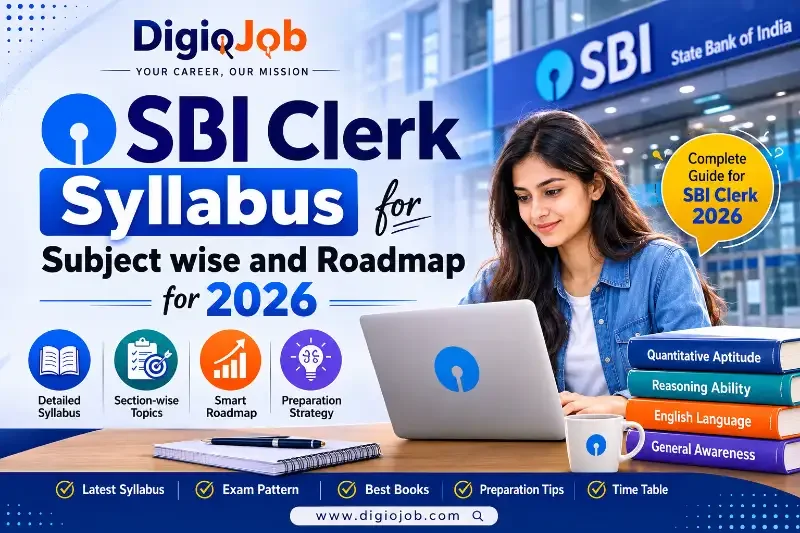
A Complete Roadmap to SBI Clerk 2026
Securing a position as a Sub‑Assistant Manager (SBI Clerk) is a dream for many aspiring banking professionals in India. The 2026 recruitment cycle will be no exception, and a clear understanding of the SBI Clerk Syllabus is the foundation of a successful preparation strategy.
This article provides a comprehensive, subject‑wise breakdown of the syllabus, exam pattern, and actionable tips to help you navigate each section with confidence. Whether you are a fresh graduate or a career changer, mastering the syllabus will position you ahead of the competition.
Exam Overview – What You Need to Know
Before diving into the detailed syllabus, it’s crucial to grasp the overall exam structure:
Stage 1 – Preliminary Examination: Consists of three sections – English Language, Quantitative Aptitude, and Reasoning Ability. Each section is of 35 marks.
Stage 2 – Main Examination: Includes five sections – English Language, Hindi Language (optional), Quantitative Aptitude, Reasoning Ability, Computer Knowledge, and General Awareness with Special Emphasis on Banking.
Stage 3 – Descriptive Paper (only for selected candidates): Tests writing skills in English or Hindi, based on a passage.
The SBI Clerk Syllabus 2026 is designed to assess both core banking competencies and general awareness, ensuring candidates are well‑rounded professionals.
Subject‑wise Syllabus Breakdown
1. English Language
This section evaluates your communication proficiency, a critical skill for customer interaction in banking.
Vocabulary: One‑word substitution, synonyms, antonyms, idioms & phrases, para‑jumbles.
Reading Comprehension: Short passages followed by questions on inference, main idea, and factual details.
Grammar & Sentence Correction: Subject‑verb agreement, tense consistency, article usage, preposition errors, voice transformation.
Error Spotting & Fill in the Blanks: Focus on contextual grammar and syntax.
Preparation Tip: Daily read an English newspaper or magazine, and practice 15‑20 questions of each sub‑topic to improve speed and accuracy.
2. Hindi Language (Optional)
Though optional, many candidates include it to increase their overall score.
Samanya Sandhi (Grammar): Sangati sandhi, vakya sandhi.
Kriyā padas (Verbs): Karni, Karm, Karta, etc.
Saṃskṛti (Culture) & Sanskriti (Civilization): Basic questions on Hindi literature and history.
Paryaay (Synonyms) & Viryuddh (Antonyms)
Ksharāvali (Vocabulary): High‑frequency Hindi words and their meanings.
Preparation Tip: Refer to NCERT Hindi textbooks up to class 10 and solve previous years’ Hindi questions.
3. Quantitative Aptitude
Mathematical proficiency is vital for banking operations and calculations.
Number Systems: LCM, HCF, Divisibility rules, Fractions & Decimals.
Simplification & Approximation: BODMAS rules, quick mental math.
Profit, Loss & Discount: Cost price, selling price, markup, and discount calculations.
Time & Work: Work‑hours, efficiency, and collaborative tasks.
Speed, Distance & Time: Relative speed, average speed problems.
Ratio & Proportion, Percentages: Data interpretation based scenarios.
Partnership, Mixtures & Alligation: Partnership profit sharing, mixture ratio calculations.
Simple & Compound Interest: Formulas and applications.
Permutations & Combinations: Arrangement and selection problems.
Probability: Basic probability concepts.
Data Interpretation: Tables, bar graphs, pie charts, line graphs – 5‑6 questions per set.
Preparation Tip: Solve at least 2–3 mock tests daily focusing on speed. Use shortcuts like Vedic math for rapid calculations.
4. Reasoning Ability
Logical reasoning is essential for decision‑making in banking.
Seating Arrangement: Linear, circular, and rectangular arrangements.
Logical Deduction: Statements, conclusions, and validity testing.
Blood Relations: Family tree puzzles.
Coding‑Decoding: Letter‑based and number‑based codes.
Series: Number series, alpha‑numeric series, and missing number series.
Syllogism: Venn diagrams and categorical reasoning.
Inequalities: Symbol‑based reasoning (greater than, less than, equal to).
Puzzles: Complex puzzles involving multiple conditions.
Direction Sense: North‑south‑east‑west, distances, and relative positions.
Clocks & Calendars: Time calculations, day‑of‑the‑week problems.
Data Sufficiency: Evaluate whether given data is enough to answer a question.
Preparation Tip: Practice reasoning puzzles daily using puzzle books and online portals. Focus on pattern recognition and time management.
5. Computer Knowledge
A relatively new addition, Computer Knowledge tests basic IT literacy.
Basics of Computers: Hardware, software, CPU, memory, storage.
Operating Systems: Windows, Linux – basic commands.
Internet & Email: Browser usage, email etiquette, attachments.
Latest News & Updates
Haryana Police SPO Recruitment 2026: 400 Special Police Officer Posts, Walk-In 24 Aug
GENERAL10वीं-12वीं पास के लिए हाई कोर्ट में नौकरी
JOB NOTIFICATIONIndia Post Office Staff car driver recruitment 2026
JOB NOTIFICATIONयूपी पुलिस कॉन्स्टेबल डीवी-पीएसटी 17 अगस्त से स्टार्ट होने हैं। ऐसे में अभ्यर्थी सभी अनिवार्य दस्तावेज पहले से ही तैयार करके रखें
Microsoft Office: Word, Excel, PowerPoint – basic operations.
Keyboard Shortcuts, Data Security, and Networking Fundamentals.
Preparation Tip: Complete a short online course on basic computer concepts and practice 20‑30 MCQs daily.
6. General Awareness with Special Emphasis on Banking
This section gauges current affairs, banking awareness, and economic trends.
Current Affairs: National & International news, sports, awards, and important dates up to July 2026.
Banking Awareness: RBI policies, monetary tools, budget highlights, PSU banks, recent mergers.
Economics: Concepts like inflation, GDP, fiscal policy, monetary policy.
Commerce & Industry: Important sectors, trade policies, and business news.
Static GK: Indian geography, history, polity, culture, science & technology.
Preparation Tip: Allocate 30 minutes each day to read a current affairs summary and update a quick‑note sheet.
Exam Pattern Details
Understanding the exact marking scheme helps in strategic preparation:
Preliminary Exam: 35 questions per section, 1 mark per correct answer, negative marking of 0.25 marks for each wrong answer.
Main Exam: 30‑40 questions per section (varies), 1 mark per correct answer, negative marking 0.25 marks.
Descriptive Paper: 2 questions, 20 marks each, based on comprehension and essay writing.
Time Management is critical: Aim to solve 10‑12 questions per section in the preliminary exam within 20 minutes each.
Open Vacnacy of SBI Clerk Junior -https://www.digiojob.com/govt-jobs/sbi-clerk-junior-associate-recruitment-2026
SBI Clerk (Junior Associate) Recruitment 2026
Effective Preparation Strategy
Phase‑1: Foundation Building (2–3 Months Before Exam)
Start by creating a syllabus checklist based on the SBI Clerk Syllabus 2026. Follow a daily schedule:
English & Hindi: 30 minutes reading + 30 minutes practice.
Quantitative Aptitude: 45 minutes topic‑wise practice.
Reasoning: 45 minutes puzzle solving.
Computer & GA: 20 minutes each.
Maintain a progress tracker to ensure all topics are covered.
Phase‑2: Practice & Mock Tests (1 Month Before)
Switch to full‑length mock tests simulating exam conditions. Analyze each test to identify weak areas and focus on them. Use the following resources:
Official SBI Clerk Mock Tests on the SBI recruitment portal.
Third‑party portals like Adda247, Examweb, and BankersAdda.
Schedule a revision day every weekend to revisit concepts.
Phase‑3: Final Sharpening (Last 7 Days)
Consolidate your preparation with:
Quick‑revision notes for each subject.
Formula sheets for Quantitative Aptitude and Reasoning.
Previous year papers to get familiar with the question pattern.
Maintain a positive mindset and practice relaxation techniques to stay calm during the exam.
Recommended Books & Online Resources
Curated reading material can accelerate your preparation:
English: "Objective English" by S.P. Singh, "Word Power Made Easy" by Norman Lewis.
Quantitative Aptitude: "Quantitative Aptitude for Competitive Examinations" by R.S. Aggarwal, "Fast Track Mathematics" by Ashish Agarwal.
Reasoning: "Logical Reasoning" by G.K. Publication, "A Modern Approach to Logical Reasoning" by R.S. Aggarwal.
Computer Knowledge: "Computer Awareness" by Arihant Publications.
General Awareness: "General Awareness for Banking Exams" by Manoj Kumar, "Current Affairs 2026" by Oracle.
Online platforms like Unacademy, Adda247, and BYJU'S also provide live classes and doubt‑clearing sessions tailored to the SBI Clerk Syllabus.
Common Pitfalls & How to Avoid Them
Over‑looking Hindi: If you’re comfortable with Hindi, don’t ignore the optional section; it can be a score booster.
Skipping Data Interpretation: Treat DI as a separate topic; practice regularly.
Poor Time Allocation: Allocate time per section based on difficulty; never exceed 20 minutes per SBI Clerk Preliminary section.
Neglecting Current Affairs: Set a daily news reading habit; focus on banking‑related updates.
Frequently Asked Questions (FAQs)
Q1: Is Hindi mandatory in the SBI Clerk Mains?
A: No, Hindi is optional. Candidates can choose to attempt English or Hindi based on their comfort.
Q2: What is the weightage of Computer Knowledge?
A: Computer Knowledge carries 20 marks in the Mains examination and is essential for scoring well.
Q3: How often should I take mock tests?
A: Aim for 3–4 full-length mocks per week during the final month of preparation.
Q4: Are there any changes in the syllabus for 2026?
A: SBI occasionally updates the syllabus; always refer to the official notification and the latest Adda247 syllabus guide for accurate information.
Conclusion – Your Next Steps to Success
Mastering the SBI Clerk Syllabus 2026 is not just about memorizing topics; it’s about building a systematic approach, consistent practice, and confidence. Use this comprehensive guide as your blueprint, follow the phase‑wise strategy, and leverage the recommended resources to stay ahead.
Take action today: Create your study schedule, start daily practice, and register for a mock test to gauge your progress. Your banking career awaits – be prepared, stay focused, and ace the SBI Clerk exam!